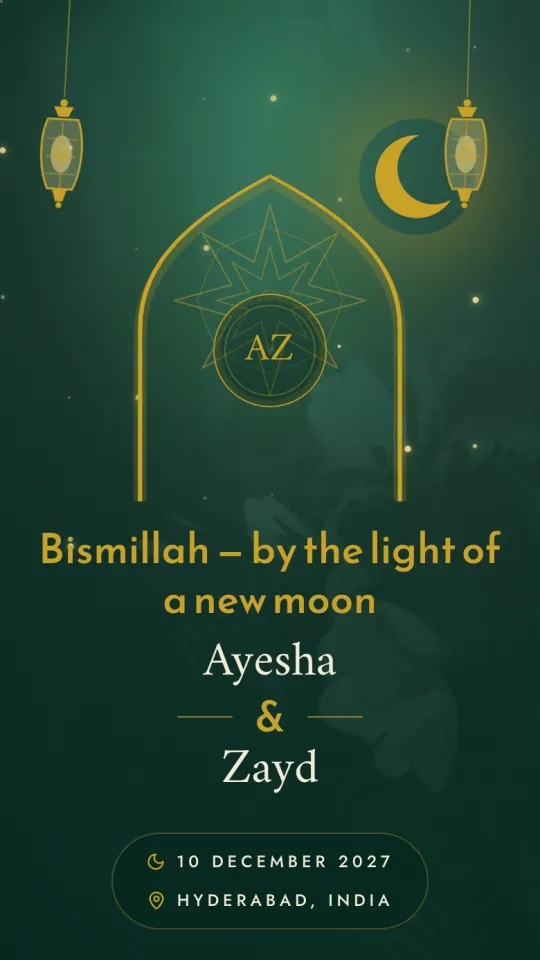
What goes on a nikah invitation
Many nikah invitations open with Bismillah, written in Arabic, in English or both. Some South Asian families print 786 in its place, and others leave the opening out, so follow your family’s custom. Many cards also add Insha’Allah before the date.
Traditionally the bride’s parents invite guests to their daughter’s nikah, and the groom’s parents invite guests to the walima. Elders are often written with Janab, Mohtarma or Begum, and many families name the grandparents whose duas they ask for.
- The opening, if your family uses one
- The hosts, then the couple’s names with their parents’ names
- Each function with its date, time, venue and map link
- Who hosts each function, especially the walima
- Any notes on seating or dress, and the date you need replies by
The functions, and who hosts each
Which functions are held, what they are called and in what order varies a great deal between communities, regions and families. List the ones your families are actually holding, using the names they use. Many South Asian weddings include some of these:
- Mangni: the engagement, often with rings and sweets exchanged between the families.
- Manjha or haldi: turmeric paste applied in the days before the wedding, with the bride often dressed in yellow.
- Mehndi: an evening of henna, often with dholak and songs.
- Baraat: the groom arrives with his family and friends.
- Nikah: the marriage itself, conducted by a qazi or imam in front of witnesses, with the nikahnama signed. It may be held in a mosque, at home or at a hall.
- Rukhsati: the bride’s farewell from her family, often on the same day as the nikah and sometimes later.
- Walima: the feast hosted by the groom’s family after the nikah, the same day or a day or two later.
The Girih template follows this shape, with a Mangni, a Rasm-e-Henna evening, the Nikah and a Walima, each on its own card. If the walima is hosted by the groom’s parents, say so in that function’s description so guests know whose invitation they are accepting.
Details guests need
A few practical lines save a lot of phone calls. Each function has its own description and dress code, which is the right place for them.
- A clock time for the nikah. Some families hold it after a prayer, such as after Asr, Maghrib or Friday prayers, so give the time guests should arrive.
- Seating arrangements, if men and women will be seated separately.
- Dress: if the nikah is in a mosque, women may want to bring a dupatta or scarf.
- Whether dinner is served after the nikah or only at the walima.
- A separate map link for the mosque and for the hall, if they differ.
Sending it and collecting replies
Send the invitation four to six weeks ahead, and earlier for guests who need to travel. In many families elders are still invited in person, with the link following so everyone has the times and maps on their phone.
Guests reply for each function, and you see each family’s reply and headcount for the mehndi, the nikah and the walima separately. That matters when the walima is a larger dinner than the nikah, or the other way round. Personal links for each family are on paid plans; the free plan has one public link.
Wording you can copy
Copy a line and change the names, dates and places to your own.
Fill in your own names, date and venue with the wording generator
بِسْمِ اللَّهِ الرَّحْمَٰنِ الرَّحِيمِ
Bismillah ir-Rahman ir-Rahim In the name of Allah, the Most Gracious, the Most Merciful
Janab Mohammed Imran Siddiqui and Mohtarma Nasreen Siddiqui request the pleasure of your company at the nikah of their daughter Ayesha with Zayd son of Janab Tariq Ahmed Qureshi and Mohtarma Rukhsana Qureshi Insha’Allah on Sunday, 12 December 2027, at 7 pm at Durbar Hall, Falaknuma, Hyderabad.
Janab Tariq Ahmed Qureshi and Mohtarma Rukhsana Qureshi invite you to the walima of their son Zayd with Ayesha on Monday, 13 December 2027, at 7:30 pm at the Ballroom, Banjara Hills, Hyderabad. Dinner will be served.
Together with our families, Sana and Imran invite you to our nikah on Friday, 4 February, after Jumu’ah, and to dinner with us at the walima that Sunday evening.
Mehndi: an evening of henna, dholak and songs at the Siddiqui home. Saturday, 11 December, from 5 pm. Wear something bright.
Kindly reply by 20 November and tell us which functions your family will attend, so both families can plan the nikah and the walima dinner.