Ponkhanu: why a Gujarati mother-in-law grabs the groom’s nose
Why does the bride’s mother try to catch the groom’s nose at a Gujarati wedding? The ponkhanu welcome at the door, the household tools, the clay saucers and what families say it means.
The jaan has danced all the way to the venue, the groom steps up to the door, and his mother-in-law is waiting with an aarti. She welcomes him warmly, circles a few odd little wooden objects over his head, and then reaches for his nose. Everyone laughs, the groom ducks, and a Gujarati wedding has officially begun. This is the ponkhanu.
What is ponkhanu?
Ponkhanu, પોંખણું, is the welcome the bride’s mother gives the groom when the jaan, the Gujarati baraat, arrives. It takes place at the toran, the decorated doorway, before the groom enters the mandap, and it is one of the most playful moments of a Gujarati Hindu wedding.
The aarti and the household tools
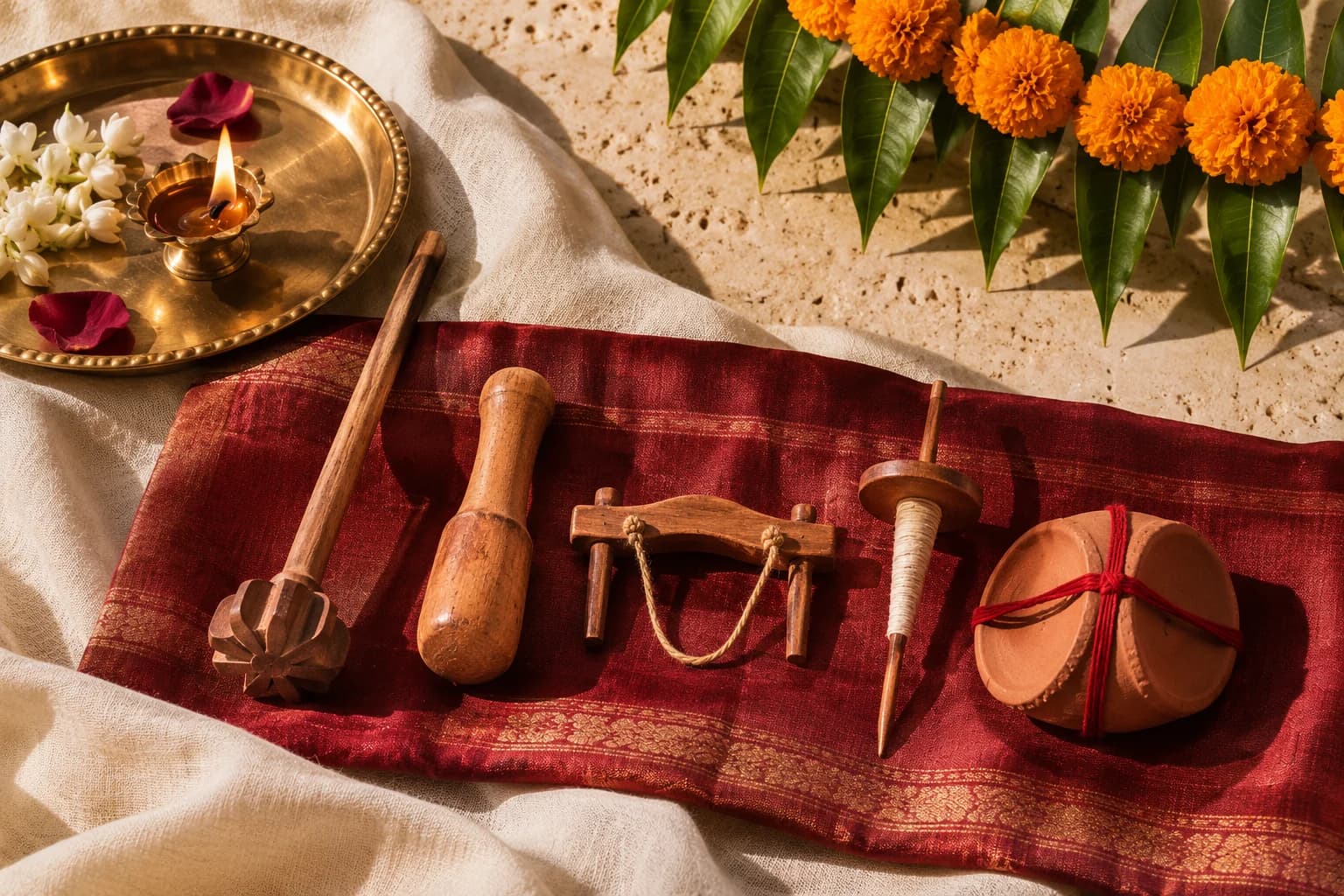
The bride’s mother begins with an aarti, then circles small household tools over the groom’s head, one after another. In many families they are a ravaiyo, the churning stick, a musal, the pestle, a dhunsari, the yoke, and a trak, the spindle, often in miniature. Families have their own explanations for each, and the set itself varies from home to home.
- Ravaiyo: a wooden churning stick
- Musal: a pestle
- Dhunsari: a yoke
- Trak: a spindle
Why she goes for his nose
Then comes the part every guest waits for: the bride’s mother tries to catch the groom’s nose. Families say it is a gentle reminder that he has come to their door to ask for their daughter’s hand, so he should stay a little humble. The groom’s side, of course, does its best to keep his nose out of reach.
Beta, haath maangne tum aaye ho. Thoda humble raho. Son, you came to ask for her hand. Stay a little humble.
The clay saucers
Before he steps inside, the groom crushes a pair of small clay saucers, placed face to face, under his foot, and only then walks into the mandap. In the mandap, the formal welcome continues with the madhuparka.
Naak pakdi, dil jeeta. Swagat, Gujarati style. Nose grabbed, heart won.
Ponkhanu on your invitation
Ponkhanu happens when the jaan arrives, so it does not need a line of its own. Give the jaan its time and the venue, and if the hast melap, when the couple’s hands are joined, is at a fixed muhurat later on, give that its own time too, so guests know how long to stay. If there is a mehndi, a garba or a sangeet in the days before, give each its own line, so guests can reply for each one.
Hindu wedding invitations: wording, functions and templates
Joota chupai: why the bride’s sisters steal the groom’s shoes
Quick answers
- What is ponkhanu? The bride’s mother’s welcome for the groom at the door when the jaan arrives at a Gujarati wedding.
- Why does the mother-in-law grab the groom’s nose? Families say it reminds him to stay humble, since he has come to ask for her daughter’s hand.
- What is circled over the groom’s head? Small household tools, in many families a churning stick, a pestle, a yoke and a spindle.
- Why does the groom break clay saucers? He crushes a pair of clay saucers underfoot before entering the mandap; families explain it in their own ways.
Written by Inviteeq Editorial, with care for every celebration.