Qubool hai: why it is said three times at a nikah
Why do the bride and groom say qubool hai three times at a nikah? What ijab and qubool mean, why the bride’s consent comes first, what mehr is, and how to invite guests.
The room goes quiet, the qazi asks a question, and the answer comes softly: qubool hai. Then again. And a third time, before the whole family breaks into mubarak. It is the moment every nikah is built around, and the words most guests know by heart. Fewer know why they are said three times, or what exactly is being accepted.
A nikah is a contract
In Islam, marriage is a contract, a solemn promise made in front of witnesses, rather than a sacrament. Its heart is two words: ijab, the offer, and qubool, the acceptance. Everything else at a nikah, the sermon, the duas, the signing of the nikahnama, gathers around that exchange.
The nikah is usually conducted by a qazi or an imam, at a mosque, at home or at a hall. He is not a priest who marries the couple; he makes sure the contract is clear and properly witnessed, and leads the prayers around it.
Why the bride is asked first
In many South Asian nikahs, the qazi goes to the bride first, often with her father or another elder and the witnesses. He names the groom and the mehr agreed for her, and asks whether she accepts. Only then does he put the same question to the groom. The order is a custom rather than a rule, and families do it differently.
What does not change is that her consent is essential. Without it, there is no nikah. The question is put to her by name, and her answer is heard by the witnesses, which is the whole point of asking it aloud.
Uski marzi ke bina, nikah hota hi nahi. Without her consent, there is no nikah at all.
Mehr: her right, not a price
Mehr is a gift from the groom to the bride, and it belongs to her alone. The Quran asks husbands to give women their mehr as a free gift (4:4). It can be money, gold or anything of value, and it can be paid at the nikah or deferred to later; families write which it is in the nikahnama.
Mehr is often confused with two very different things. It is not dahej, the dowry some families expect from the bride’s side, and it is not a price paid for her. It runs the other way: a right she holds, named in front of everyone before she says yes.
So why three times?
To be honest, once is enough. One clear acceptance, heard by the witnesses, completes the contract, and scholars say saying it three times is not required. Saying it three times is a tradition: it leaves no doubt about what was said, and makes sure every witness and everyone in the room hears it.
Qubool hai. Qubool hai. Qubool hai. Teen baar, ek hi vaada. Three times, one promise.
What happens after qubool hai
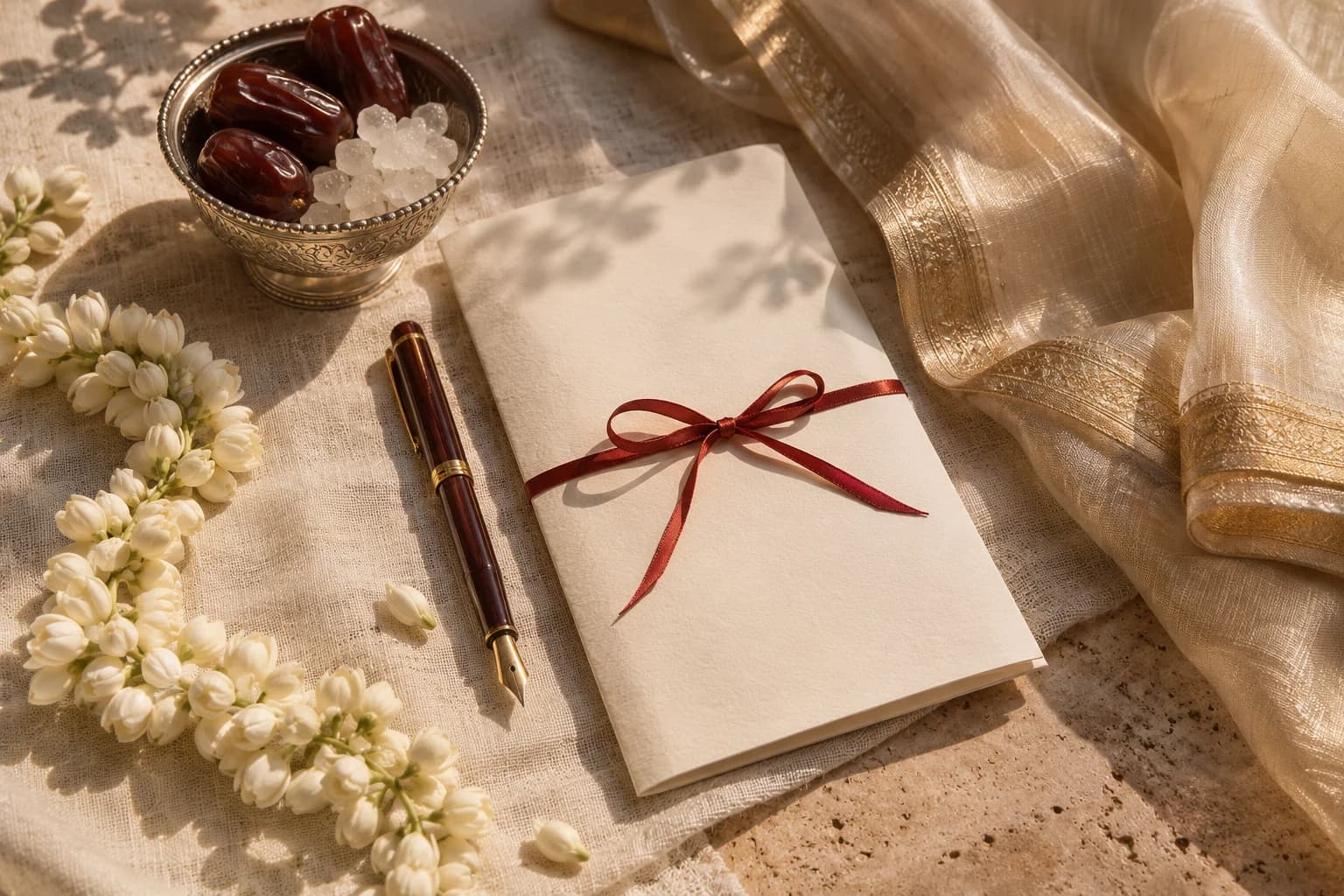
The nikahnama is signed by the couple, the witnesses and the qazi, and the gathering raises its hands for a dua for the couple. In many South Asian families dates and dry fruit are handed round, and the mubarakbaad begins. The rukhsati, the bride’s farewell, may follow the same day or later, and the groom’s family hosts the walima.
Walima: why the groom’s family hosts the wedding feast
The nikah on your invitation
Give the nikah a clock time, even if your family holds it after a prayer, so guests know when to arrive. If the nikah is at a mosque and dinner is at a hall, give each its own venue and map link, and say whether dinner follows the nikah or waits for the walima. Put the mangni, mehndi, nikah and walima on one invitation, and guests can reply for each one.
Nikah invitation wording and templates
Quick answers
- Why is qubool hai said three times? By tradition, so the acceptance is unmistakable and every witness hears it. Once is enough for the nikah to be valid.
- What do ijab and qubool mean? Ijab is the offer and qubool the acceptance. Together they make the nikah contract.
- Is the bride’s consent required? Yes. Without her consent there is no nikah.
- Is mehr the same as dowry? No. Mehr is the groom’s gift to the bride and belongs to her alone; dowry runs the other way.
Written by Inviteeq Editorial, with care for every celebration.